Korea’s Serial Deal-Maker: From Lazertinib Royalties to a Global Licensing Platform
| Ticker | KOSDAQ: 039200 |
| Current Price (June 2026) | ~42,200 KRW |
| Market Cap | ~1.6 trillion KRW (~USD 1.2B) |
| Sector | Biopharma / Drug Discovery |
| Report Date | Jun 07, 2026 |
1. Executive Summary
Oscotec Inc. (KOSDAQ: 039200) is a South Korean clinical-stage biotechnology company that has quietly transformed from a small-molecule drug discovery shop into one of Korea’s most prolific biopharma licensing platforms. Founded in 1998 and listed on KOSDAQ in 2007, Oscotec’s defining achievement is the origination of lazertinib — a third-generation EGFR inhibitor now commercialized globally as Lazcluze (J&J/Janssen) — from which the company receives a 20% share of all milestone and royalty payments flowing to the Yuhan-Genosco-Oscotec consortium. This royalty stream, now materially growing following Lazcluze’s US FDA approval in August 2024, provided the financial foundation for a burst of out-licensing activity in 2025–2026 that has re-rated the investment thesis significantly.
In December 2025, co-development partner ADEL concluded a $1.04 billion licensing deal with Sanofi for ADEL-Y01 (tau-targeted Alzheimer’s antibody), generating upfront proceeds for Oscotec. In March 2026, Yatiri Bio optioned denfivontinib (FLT3/AXL dual inhibitor, AML) from Oscotec. Most recently, in June 2026, Agios Pharmaceuticals signed a deal worth up to $165 million (USD) for cevidoplenib (SYK inhibitor, ITP), with $25 million paid upfront. In under seven months, Oscotec has inked three separate technology licensing transactions — delivering on its stated ambition of at least three global deals by 2030.
FY2025 results confirmed the inflection: consolidated revenue reached KRW 99.8 billion (+193.5% YoY), driven by Lazcluze milestone payments from Japan/China commercialization and ADEL-Y01-related technology income. Operating income swung to positive for the first time at KRW 52.1 billion, with an operating margin of approximately 52%.
| Investment Thesis in One Line: Oscotec is transitioning from a single royalty recipient into a multi-asset licensing platform — with growing recurring cash flows from lazertinib, new near-term milestones from cevidoplenib, and a large unmonetized pipeline in Genosco. The key question is whether the remaining pipeline assets can generate the next wave of deals at meaningful scale. |
Reference: https://oscotec.co.kr/
2. Company Overview
2.1 Corporate History and Structure
Oscotec was incorporated in December 1998 by founder Kim Jeong-geun, whose background spanned medicinal chemistry and drug development. The company listed on KOSDAQ in January 2007. The corporate structure comprises three core segments:
- Innovative Drug R&D: Discovery and clinical development of novel small molecules and biologics, primarily in oncology and immunology. This segment generates technology licensing fees, milestone payments, and royalties.
- Functional Materials / Nutraceuticals: Sales of functional food ingredients and health products — a modest but stable revenue contributor.
- Dental Healthcare: Manufacture and sale of dental bone graft materials, membranes, and related dental consumables — a legacy cash-generative segment.
The company’s most important strategic subsidiary is Genosco, Inc., a Boston-based R&D arm. Genosco was the scientific origin point of lazertinib and continues to advance kinase inhibitor and targeted protein degradation (TPD) programs. The Oscotec-Genosco relationship is financially intertwined, with the parent funneling R&D capital into Genosco while receiving shared revenues from deal proceeds.
Following the passing of founder Kim Jeong-geun in February 2026, CEO Yoon Tae-young has emphasized board-centric governance continuity and reaffirmed the company’s dual-hub model: Oscotec as the Korean entity for deal structuring and investor relations, and Genosco as the US-facing R&D hub to engage global pharma partners.
2.2 Key Personnel
| Name | Role | Background |
| Yoon Tae-young | CEO, Oscotec | Long-tenured executive; architect of the licensing-first strategy; active deal spokesperson |
| Yoon Seung-yong (Prof.) | CEO, ADEL Inc. | Founder of ADEL; Professor at Asan Medical Center, Univ. of Ulsan; originator of tau-acetylation biology |
| Genosco Leadership | R&D Hub (Boston) | Scientific team responsible for kinase inhibitor and TPD platform development |
3. Technology Platform Analysis
3.1 Small Molecule Drug Discovery Engine (Oscotec / Genosco)
Oscotec’s foundational competence is in kinase biology and medicinal chemistry. The company employs structure-activity relationship (SAR)-driven optimization to identify novel kinase inhibitors with improved selectivity profiles versus first-generation compounds. This platform has produced lazertinib, cevidoplenib, and denfivontinib — all targeting distinct kinase families with documented clinical proof-of-concept.
Key platform characteristics:
- Next-generation selectivity: All major Oscotec clinical candidates are framed as improved-selectivity analogs of validated first-in-class agents (e.g., cevidoplenib vs. fostamatinib for SYK; lazertinib vs. osimertinib for EGFR). This de-risks target biology while creating room for differentiation on safety/tolerability.
- Genosco’s US presence enables rapid access to FDA regulatory pathways and engagement with US academic medical centers for clinical partnerships.
- Targeted Protein Degradation (TPD): Genosco is actively building a PROTAC/degrader platform, representing the next wave of pipeline assets planned for 2026–2028 development initiation.
3.2 Lazertinib (Lazcluze) — The Foundational Asset
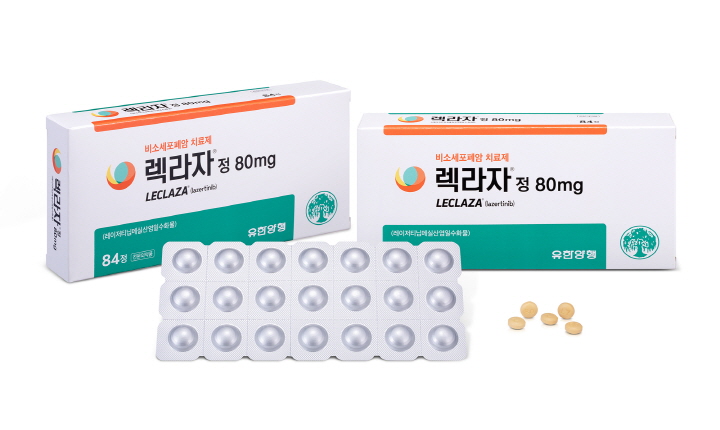
Lazertinib is a third-generation, irreversible EGFR tyrosine kinase inhibitor (TKI) that selectively targets the T790M resistance mutation and activating EGFR mutations, while demonstrating superior CNS penetration compared to first- and second-generation EGFR TKIs. It was originally synthesized and optimized by Genosco (then operating within the Oscotec ecosystem) before being licensed to Yuhan Corporation in 2015.
The commercial ramp:
- August 2024: Lazcluze + amivantamab (Rybrevant) combination received first-line FDA approval for EGFR-mutated NSCLC — the first and only chemotherapy-free, multitargeted first-line combination in this setting.
- 2025: Approvals in Japan (March), China (July), and Europe (ongoing) expanded the addressable market to multiple major oncology markets.
- Revenue split: J&J/Janssen pays Yuhan Corporation, which distributes 60% to itself and 20% each to Oscotec and Genosco from both milestone and royalty flows.
- Market penetration: As of mid-2025, Lazcluze+Rybrevant captured approximately 25% of newly diagnosed EGFR-mutated NSCLC patients in the US. J&J projects peak sales potential of USD 5 billion annually for the combination.
- Yuhan’s cumulative milestone receipts from Janssen have reached USD 300 million as of May 2026 (including the latest EUR commercialization milestone), with approximately two-thirds of the total USD 950 million deal value still to be triggered.
| Oscotec’s Royalty Entitlement: With Lazcluze global sales on track to exceed KRW 1 trillion (~USD 730M) by 2027, and Oscotec entitled to ~20% of Yuhan’s ~10% royalty on those sales, Oscotec’s annualized royalty income (ex-milestones) could approach KRW 15–20 billion in a base case and KRW 30+ billion in a bull scenario if market share continues to expand. |
3.3 Tau Acetylation Biology (ADEL Platform)
Through its joint R&D agreement with ADEL Inc. (since 2020), Oscotec co-developed ADEL-Y01, a humanized monoclonal antibody targeting tau acetylated at Lysine-280 (acK280). This is mechanistically distinct from total-tau targeting approaches (such as those from other developers): by focusing on the acetylated form, ADEL-Y01 selectively disrupts toxic tau species implicated in neurodegeneration while theoretically preserving the function of normal microtubule-associated tau.
The December 2025 Sanofi licensing deal at up to USD 1.04 billion (USD 80 million upfront + milestones + double-digit tiered royalties) represents external validation of this differentiated mechanism. Sanofi, which has been actively building a neurology franchise (including the Vigil Neuroscience/TREM2 acquisition), selected ADEL-Y01 as a potential cornerstone of its Alzheimer’s pipeline.
3.4 Targeted Protein Degradation (Genosco Pipeline)
Genosco has disclosed an active TPD program, though specific compounds have not yet been named publicly. TPD represents the strategic next horizon for Oscotec/Genosco — the company has signaled plans to identify at least two new lead compounds and advance them to the clinical stage by the late 2020s, funded by growing lazertinib cash flows. The focus area for new pipeline assets is expected to be chemotherapy resistance mechanisms, a therapeutic area the company views as underserved across all stages of drug development.
4. Pipeline Analysis
4.1 Pipeline Summary Table
| Asset | Mechanism | Indication | Stage | Partner / Status |
| Lazertinib (Lazcluze) | EGFR TKI (3rd gen) | NSCLC (1L/2L) | Commercialized | Yuhan / J&J Janssen (global) |
| ADEL-Y01 | Anti-acK280 tau mAb | Alzheimer’s Disease | Phase 1 (FIH) | Licensed to Sanofi (Dec 2025) |
| Cevidoplenib | SYK inhibitor (next-gen) | ITP; other autoimmune | Phase 2 (ITP done); Phase 3 planned 2028 | Licensed to Agios (Jun 2026) |
| Denfivontinib (SKI-G-801) | FLT3/AXL dual inhibitor | AML; solid tumors | Phase 1 complete | Optioned by Yatiri Bio (Mar 2026) |
| OCT-598 | Undisclosed (chemo resistance) | Oncology | Preclinical | Oscotec (internal) |
| TPD Program (Genosco) | PROTAC/Degrader | TBD (oncology/immunology) | Discovery | Genosco (internal) |
4.2 Asset Deep Dives
Cevidoplenib (SYK Inhibitor) → Agios Pharmaceuticals
Cevidoplenib is a next-generation oral SYK inhibitor designed with improved selectivity over the first-approved SYK inhibitor fostamatinib (Rigel’s Tavalisse). It received FDA Orphan Drug Designation for ITP in March 2024. Oscotec ran a Phase 2 trial in ITP; while the primary endpoint did not achieve statistical significance, secondary endpoints showed clinically meaningful platelet responses and a favorable tolerability profile that distinguished it from fostamatinib’s off-target cardiovascular and gastrointestinal effects.
Deal terms (June 1, 2026): Agios receives exclusive global rights across all indications. Oscotec receives USD 25 million upfront, up to USD 140 million in development/regulatory milestones for up to three indications, plus commercial milestones and tiered royalties (high single digit to mid-teen %). Oscotec retains South Korean co-promotion rights. Agios targets Phase 3 initiation in H1 2028. Peak US sales potential has been cited at up to USD 1 billion.
Denfivontinib (FLT3/AXL Dual Inhibitor) → Yatiri Bio
Denfivontinib (SKI-G-801) is a multikinase inhibitor that targets FLT3 (wild-type, FLT3-ITD, FLT3-D835Y mutations) and AXL — two oncogenic drivers frequently co-expressed in AML and associated with treatment resistance. Oscotec completed a Phase 1 trial in relapsed/refractory AML (NCT03564288, 14 patients enrolled 2018–2021). Yatiri Bio’s ProteoCharts AI platform identified a novel, FLT3-independent biomarker signature of responders, potentially expanding the addressable patient population.
Deal terms (March 24, 2026): Yatiri Bio holds an exclusive global option to license denfivontinib; financial terms were undisclosed. This is an earlier-stage deal than cevidoplenib, with value contingent on biomarker-driven clinical de-risking. Oscotec retains Korean rights.
ADEL-Y01 (Tau Antibody) → Sanofi
ADEL-Y01 is in a global Phase 1 first-in-human study under FDA-cleared IND. The target, acK280 tau, sits at the intersection of tau aggregation and propagation — the two key drivers of Alzheimer’s neurodegeneration. Unlike amyloid-targeting drugs (lecanemab, donanemab), ADEL-Y01 directly addresses tauopathy, which is more proximal to neuronal death. Sanofi’s USD 1.04 billion deal (USD 80M upfront + milestones + tiered royalties up to double-digits) positions ADEL-Y01 as a potential best-in-class tau therapeutic.
Oscotec’s economic entitlement: As a 50% co-developer under the joint R&D agreement with ADEL, Oscotec receives a share of the upfront and future milestone/royalty streams. The exact split has not been publicly disclosed, but industry convention for 50/50 co-development arrangements suggests a meaningful proportion of the USD 80 million upfront was distributed to Oscotec, contributing materially to FY2025 revenue.
5. Financial Analysis
5.1 Historical Financial Performance (KRW Billion)
| Metric | FY2022A | FY2023A | FY2024A | FY2025A |
| Revenue | 5.0 | 5.0 | 34.0 | 99.8 |
| Revenue Growth (%) | — | 0% | +580% | +194% |
| Gross Profit | 3.0 | 3.0 | 32.0 | ~97.0 |
| Gross Margin (%) | ~60% | ~60% | ~94% | ~97% |
| SG&A / R&D Opex | 32.0 | 36.0 | ~34.0 | ~47.7 |
| Operating Income | (29.0) | (33.0) | (2.9) | 52.1 |
| Operating Margin (%) | neg. | neg. | neg. | 52.1% |
| EBITDA | neg. | neg. | neg. | ~53.7 |
| Net Income | neg. | neg. | neg. | ~60.8 |
Note: FY2025 financials reflect the inflection point driven by (1) Lazcluze milestone payments from Japan and China commercialization events; (2) ADEL-Y01 upfront revenue from the Sanofi deal; and (3) growing royalty income from expanding global Lazcluze prescriptions. Cost base remained disciplined (SG&A/R&D ~KRW 47.7 billion), producing an operating profit reversal for the first time in the company’s history as a drug developer.
5.2 Revenue Composition (FY2025 Estimated)
Oscotec’s revenues in FY2025 were predominantly derived from:
- Lazcluze milestone payments (Japan & China commercialization): Primary driver — Yuhan received ~USD 15M (Japan, May 2025) and ~USD 45M (China, Oct 2025) from Janssen, of which Oscotec’s 20% share equals approximately KRW 8–12 billion.
- ADEL-Y01 / Sanofi upfront: USD 80M total deal upfront received by ADEL, partially distributed to Oscotec per co-development agreement — estimated KRW 40–60 billion range contributing to consolidated revenue.
- Lazcluze royalties: Growing royalty stream as global prescription volumes expand. Yuhan received ~KRW 9.3 billion cumulative through Q3 2025; Oscotec’s share (20%) would equate to ~KRW 1.9 billion for the period.
- Dental and functional food: Stable legacy revenues, estimated KRW 3–5 billion.
5.3 Balance Sheet Highlights
As of the most recent disclosures:
- Cash & near-cash: Approximately KRW 1.1 trillion (~USD 800M) as reported in early 2025 — a war chest built from Lazcluze deal proceeds accumulated over multiple years. This substantial cash position underpins Genosco’s R&D funding and supports any future M&A optionality.
- Minimal debt: Oscotec operates with no meaningful financial leverage, making the balance sheet a strategic asset rather than a risk factor.
- Genosco funding: The parent has historically funded Genosco’s operations from its own balance sheet, which has been a point of governance debate (see Genosco IPO controversy, March 2025) but provides Genosco with operational stability without external funding constraints.
5.4 Revenue Forecast (Base Case, KRW Billion)
| Revenue Stream | FY2026E | FY2027E | FY2028E | FY2029E | FY2030E |
| Lazcluze Royalties | 15–20 | 25–35 | 35–50 | 40–60 | 45–65 |
| Lazcluze Milestones | 30–50 | 20–40 | 10–30 | 10–20 | 5–15 |
| Cevidoplenib (Agios milestones) | 25 | 5–15 | 5–20 | 10–30 | 15–40 |
| ADEL-Y01 / Sanofi milestones | 0–10 | 10–30 | 20–50 | 30–80 | 50–100 |
| Denfivontinib / Other deals | 0–5 | 5–10 | 5–15 | 5–20 | 10–30 |
| Legacy (dental, food, etc.) | 5 | 5 | 5 | 5 | 5 |
| Total Estimated Revenue | 75–115 | 70–135 | 80–170 | 100–215 | 130–255 |
Note: Forecasts are highly uncertain and dependent on clinical progression, milestone achievement timing, and deal-by-deal economics. The range is intentionally wide to reflect binary event risk across multiple programs.
6. Valuation — rNPV-Based Market Capitalization Analysis
6.1 Valuation Methodology
We value Oscotec using a risk-adjusted Net Present Value (rNPV) approach, summing the probability-weighted present values of each pipeline asset and revenue stream, plus a net cash value of the balance sheet. This is the most appropriate framework for pre- or early-commercial stage biopharma companies with lumpy, milestone-driven revenue profiles. We use a discount rate of 12% (reflecting KOSDAQ biopharma risk premia and Korea-specific cost of capital) and KRW/USD exchange rate of 1,380.
6.2 Component Valuation
| Value Component | Bear Case (KRW B) | Base Case (KRW B) | Bull Case (KRW B) | Key Assumption |
| Lazcluze Royalties & Milestones (NPV) | 300 | 600 | 1,000 | Global peak sales USD 2–5B; Oscotec 20% of Yuhan’s 10% royalty |
| Cevidoplenib (rNPV, 30% PoS for 3 indications) | 50 | 150 | 280 | Agios Phase 3 success; peak US sales USD 500M–1B |
| ADEL-Y01 / Sanofi (rNPV, 12% PoS Ph1→Approval) | 30 | 120 | 350 | Phase 1 safety; tau MOA validation; global Alzheimer’s market |
| Denfivontinib (rNPV, 15% PoS) | 10 | 40 | 100 | Yatiri biomarker-driven Phase 2; FLT3-ind. patient selection |
| New Pipeline (OCT-598 + TPD; option value) | 20 | 100 | 300 | At least 2 new clinical candidates by 2030; licensing deals |
| Net Cash Position | 800 | 900 | 1,000 | KRW ~1.1T cash minus R&D burn and operational costs |
| Legacy Businesses (DCF) | 30 | 50 | 70 | Stable dental and functional food revenues, minimal growth |
| Total Fair Value | 1,240 | 1,960 | 3,100 | Sum of components |
6.3 Fair Value Per Share
| Scenario | Total Value (KRW B) | Shares Outstanding (~38.3M) | Fair Value / Share | vs. Current Price (~42,200 KRW) | Upside / Downside |
| Bear Case | 1,240 | 38.3M | ~32,400 KRW | 42,200 KRW | -23% |
| Base Case | 1,960 | 38.3M | ~51,200 KRW | 42,200 KRW | +21% |
| Bull Case | 3,100 | 38.3M | ~80,900 KRW | 42,200 KRW | +92% |
Analyst consensus (as of March 2026) had a target price of KRW 75,000 — roughly midway between our base and bull cases. This reflects the market’s growing recognition of Oscotec’s licensing momentum, though it likely does not yet fully discount the cevidoplenib-Agios deal (announced June 2026) or the full ramp potential of Lazcluze European royalties.
| Current market price of ~42,200 KRW implies significant value gap versus a base case fair value of ~51,200 KRW, and approximately 92% upside to a bull case that assumes broader clinical success across the pipeline. The bear case (32,400 KRW) represents the scenario where lazertinib royalties plateau early and cevidoplenib/ADEL-Y01 fail to generate substantial milestone flows — a meaningful but manageable downside given the cash cushion. |
6.4 Key Valuation Sensitivities
| Variable | Bear Assumption | Base Assumption | Bull Assumption | NPV Sensitivity |
| Lazcluze peak sales (global) | USD 2B | USD 3.5B | USD 5B | ±KRW 300–400B |
| Cevidoplenib PoS (Phase 3) | 15% | 30% | 50% | ±KRW 100–130B |
| ADEL-Y01 PoS (Ph1 → Approval) | 6% | 12% | 20% | ±KRW 80–230B |
| Discount Rate | 15% | 12% | 10% | ±15–20% on total NPV |
| KRW/USD Exchange Rate | 1,450 | 1,380 | 1,300 | ±5–8% on total NPV |
| New Deal Activity (2026–2030) | 0 deals | 2 deals | 4+ deals | ±KRW 200–300B |
7. Key Risks
7.1 Clinical / Scientific Risks
- Lazertinib competitive pressure: AstraZeneca’s osimertinib (Tagrisso) continues to grow prescriptions. The Lazcluze+Rybrevant combination needs to demonstrate durable OS superiority to capture further market share. If MARIPOSA-2/3 long-term data disappoint, royalty ramp could stall.
- ADEL-Y01 Phase 1 safety / efficacy: Early-phase Alzheimer’s antibodies carry high failure risk (Phase 2/3 attrition is exceptionally high in AD). A safety signal in Phase 1 would eliminate this NPV component.
- Cevidoplenib Phase 3 design risk: The Phase 2 primary endpoint miss limits the upfront deal value and introduces uncertainty around Phase 3 endpoint selection and sample size. If Phase 3 is poorly designed or underpowered, the asset could fail despite biological signals.
- Denfivontinib biomarker dependency: Yatiri Bio’s thesis relies on a novel, FLT3-independent biomarker signature that has not yet been clinically validated. If the biomarker fails to stratify responders, the asset may not proceed to licensing.
7.2 Commercial / Structural Risks
- Revenue concentration: Oscotec’s cash flows remain heavily dependent on the Lazcluze ecosystem. A regulatory setback (label restriction, post-marketing safety issue) or competitive disruption would disproportionately impact revenue.
- Genosco IPO governance risk: Plans for a separate KOSDAQ listing of Genosco remain subject to regulatory review (duplicate listing concerns) and investor skepticism. If executed poorly, the IPO could redistribute value away from current Oscotec shareholders or create structural complexity that obscures the investment case.
- Deal-making cadence: The company’s growth strategy depends on securing additional licensing transactions. Competition for global pharma deal flow is intense, and Korean biotech companies face perception challenges with some partners regarding clinical data quality and regulatory track records.
7.3 Macro / Governance Risks
- Founder succession: The passing of founder Kim Jeong-geun (February 2026) introduces potential governance uncertainty, though the board has emphasized stability and continuity under CEO Yoon.
- Korean biotech sector sentiment: KOSDAQ biotech valuations are sensitive to global risk appetite, sector rotation, and individual trial read-outs from peer companies. Broad sector de-rating would pressure Oscotec’s multiple.
- FX risk: As a KRW-reporting company with USD-denominated revenues (milestone and royalty payments from Janssen, Agios, Sanofi), Oscotec is exposed to KRW appreciation risk.
8. Outlook and Catalysts
8.1 Near-Term Catalysts (H2 2026)
- European Lazcluze royalties: With EU commercialization underway, royalty income from European prescriptions will contribute to revenue for the first time in H2 2026, adding an incremental KRW 3–8 billion annually in the near term.
- Cevidoplenib Phase 3 design publication: Agios is expected to finalize Phase 3 trial design and announce IND filing plans. Positive development would confirm the asset’s value trajectory.
- ADEL-Y01 Phase 1 interim data: As the first-in-human study progresses, interim safety and PK data will be critical for validating the MOA and supporting Sanofi’s advancement to Phase 2.
- New pipeline deal(s): Management has guided for at least 3 global deals by 2030; with two complete as of mid-2026 (ADEL-Y01/Sanofi, cevidoplenib/Agios), the third deal announcement would be a meaningful re-rating catalyst.
- Genosco IPO resolution: A definitive decision on the Genosco separate listing — whether proceeding or withdrawn — will clarify the structural risk that has overhung the stock.
8.2 Medium-Term Catalysts (2027–2030)
- Lazcluze US regulatory milestones: J&J may pursue label expansions (additional EGFR mutations, earlier treatment lines, adjuvant settings) — each triggering additional milestone payments distributed to the Yuhan-Oscotec consortium.
- ADEL-Y01 Phase 2 initiation: Sanofi advancing ADEL-Y01 into Phase 2 would trigger a major milestone payment and validate the Phase 1 data package.
- Cevidoplenib Phase 3 readout: Expected no earlier than 2029. A positive result would trigger commercial milestones and initiate royalty flows, potentially the largest single value-creation event in this timeframe.
- New asset licensing: Oscotec’s OCT-598 chemotherapy-resistance program and Genosco’s TPD pipeline are expected to generate IND filings by 2028–2029, setting up a new wave of global licensing deals.
- Global lazertinib royalty ramp: Management estimates lazertinib’s global sales could cross KRW 1 trillion (USD 725M) by 2027, with royalty income scaling proportionally — potentially representing the largest single annual cash flow contributor.
8.3 Strategic Positioning
Oscotec is executing a distinctive model in Korean biopharma: discovery in Seoul/Boston → internal clinical de-risking → out-licensing to global partners for late-stage development and commercialization. This asset-light approach minimizes the capital-intensive late-stage development burden while preserving residual royalty and milestone economics. The cash reserves from the Lazcluze ecosystem provide a multi-year runway to fund Genosco’s next-generation pipeline without equity dilution.
The company’s stated goal — a minimum of three global licensing deals by 2030 — is now 67% achieved within the first half of 2026. With a growing number of clinical-stage assets and a validated track record with global partners (J&J, Sanofi, Agios), the dealmaking credibility to secure further transactions is meaningfully higher today than it was 24 months ago.
9. Investment Conclusion
Oscotec is at an inflection point that few Korean biotech companies have reached: the transition from R&D-stage cash burn to a self-sustaining licensing platform generating material, recurring revenue. The Lazcluze royalty engine provides a durable, growing cash flow base; the cevidoplenib-Agios and ADEL-Y01-Sanofi deals confirm the company’s ability to attract global pharma partners; and the pipeline-in-reserve at Genosco provides optionality for the next valuation re-rating.
At the current price of approximately KRW 42,200, Oscotec trades at a meaningful discount to our base case fair value of KRW 51,200 (21% upside) and a substantial discount to the bull case of KRW 80,900 (92% upside). The primary risks are lazertinib competitive dynamics and late-stage clinical trial failure rates for ADEL-Y01 and cevidoplenib — both legitimate but manageable within the context of Oscotec’s asset diversification and cash cushion.
| Overall Assessment: The risk-reward at current levels appears attractive for investors with a 2–3 year time horizon, particularly given the near-term catalyst density (EU royalties, cevidoplenib Phase 3 design, ADEL-Y01 Phase 1 data, potential third licensing deal). Oscotec warrants accumulation on weakness and is a core holding within the Korean biopharma licensing theme. Primary watch items: Lazcluze market share data vs. Tagrisso, Genosco IPO outcome, and cevidoplenib Phase 3 design quality. |
Disclaimer
This report is prepared for informational purposes only and does not constitute investment advice or a solicitation to buy or sell any securities. All financial projections and valuations are based on publicly available information and analyst estimates as of June 2026. Actual results may differ materially from projections due to clinical, regulatory, commercial, and macro risks. Readers should conduct their own due diligence and consult with qualified financial advisors before making investment decisions.



답글 남기기